Google Ads Has Changed. Here’s What That Means for Your Campaigns
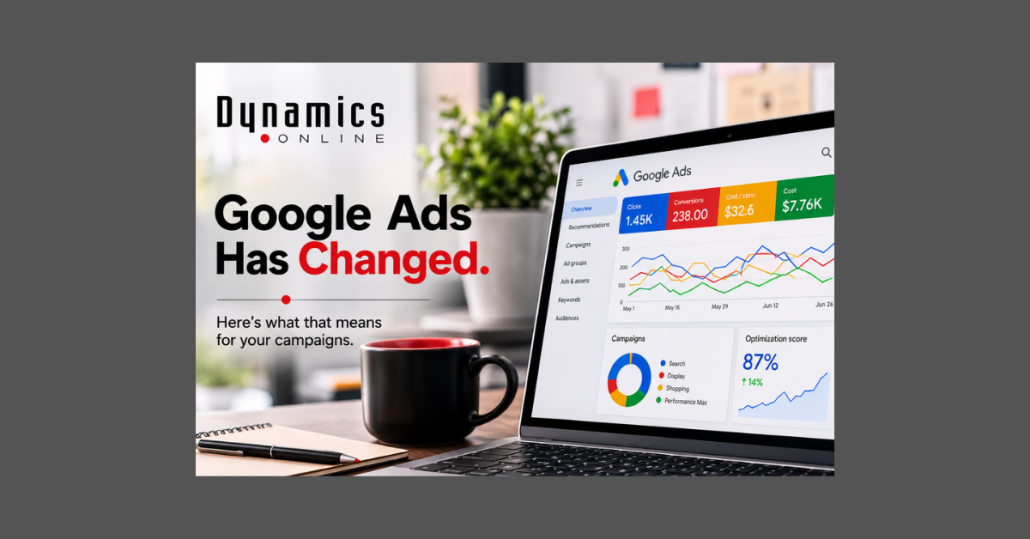
If you’ve been running Google Ads for several years, you may have noticed something: Google Ads doesn’t work quite the way it used to.
The platform has always evolved, but the changes happening now are bigger than a new button or reporting feature. Google is increasingly using artificial intelligence to determine when ads appear, who sees them, how much advertisers bid and even which combination of ad messaging is shown.
For businesses, that creates new opportunities—but it also means some of the strategies that worked a few years ago need to be reconsidered.
At Dynamics Online, we’ve been reviewing and restructuring client campaigns to make sure they’re built for the way Google Ads works today.
So, what exactly changed?
Let’s keep it simple.
The Old Google Ads Was Much More Manual
Google Ads used to give advertisers considerably more direct control over campaigns.
We selected very specific keywords.
We chose how closely a person’s search needed to match those keywords.
We created ads for tightly defined groups of searches.
We manually adjusted bids.
Then we monitored results and made adjustments.
For example, if a Cleveland manufacturer wanted to advertise for “custom metal fabrication,” we might build an ad group specifically around searches for custom metal fabrication.
The keywords, ads and landing page would all closely relate to that particular service.
That basic principle—relevance—is still extremely important.
What’s changing is how Google determines that relevance.
Google Is Getting Much Better at Understanding Intent
Google increasingly wants advertisers to think beyond the exact words someone types into the search box.
Why?
Because people don’t always search neatly.
Someone looking for a commercial HVAC company might search:
“commercial HVAC repair”
But they might also ask:
“who can fix the heating system in my office building?”
The wording is completely different, but the intent could be exactly the same.
Google’s AI is becoming better at recognizing those connections.
Tools such as AI Max for Search can expand beyond an advertiser’s traditional keyword list by using information from keywords, ads and website content to identify additional relevant searches.
That’s potentially powerful.
But there’s an important catch.
Google’s AI needs good information to work with.
Campaign Structure Still Matters
With all of Google’s automation, it might seem logical to simply create a campaign, give Google a budget and let the system figure everything out.
We don’t recommend that approach.
Automation works best when it has a strong foundation.
That means we still need to think strategically about how campaigns are organized.
Campaigns should reflect real business goals.
Ad groups should represent closely related services or products.
Keywords should help establish customer intent.
Ads should clearly communicate why someone should choose the business.
Landing pages should actually answer the question that brought someone there.
Think of Google AI as an extremely powerful engine.
Our job is still to make sure we’re pointing it in the right direction.
Keywords Are Changing, Not Disappearing
Keywords remain important, but their role is evolving.
Historically, advertisers relied heavily on Exact Match and Phrase Match keywords to control which searches could trigger their ads.
Today, Google’s matching technology can understand much broader variations in how people search.
That can uncover opportunities we might never have found by manually building enormous keyword lists.
But broader reach can also create wasted spending if campaigns aren’t monitored carefully.
That’s why one of the most important places we look when optimizing campaigns is the Search Terms Report.
Your keywords tell us what we asked Google to target.
Your search terms tell us what people actually searched.
That difference matters.
If we discover irrelevant searches triggering ads, we can add negative keywords and help prevent the campaign from spending money on searches that aren’t likely to generate business.
If we discover valuable searches we hadn’t considered, we can use that information to improve keywords, ads and even website content.
Your Ads Need More…and Better…Creative
Another major shift involves ad creative.
Google increasingly assembles ads dynamically based on what it believes will resonate with an individual searcher.
That means providing Google with strong assets has become increasingly important.
Instead of relying on one or two versions of an ad, we’re looking at the entire collection of messaging available within the campaign:
Headlines.
Descriptions.
Sitelinks.
Callouts.
Images where appropriate.
Calls to action.
Service benefits.
Competitive differentiators.
Giving Google more options doesn’t mean throwing random copy into an account.
The quality of those options matters.
Our goal is to give the system enough strong, relevant messaging to test while maintaining the client’s brand and communicating what actually makes the business different.
Conversion Tracking Matters More Than Ever
This may be the most important change for businesses to understand.
Google’s automated bidding systems learn from conversions.
In simple terms, Google needs to know what a successful customer interaction looks like.
Is it a phone call?
A completed contact form?
A purchase?
A qualified lead?
A booked appointment?
If conversion tracking isn’t configured correctly, Google may optimize toward the wrong behaviors—or have too little information to optimize effectively at all.
That’s why we’re paying close attention not just to clicks and impressions, but to what happens after someone clicks.
A campaign generating 1,000 clicks isn’t necessarily better than one generating 300.
If those 300 clicks produce more qualified leads, that’s the campaign we want.
We’re Looking Beyond Clicks
Clicks and impressions are easy numbers to report.
They’re also not necessarily business results.
Our goal isn’t simply to get more people to click an ad.
We want the right people clicking.
That means we’re evaluating campaigns based on metrics such as conversion rate, cost per conversion, search intent, search terms, lead quality and overall return on advertising spend.
We’re also looking at whether landing pages support the campaign.
You can build an excellent Google Ads campaign and still struggle to generate leads if the page users land on is slow, confusing or doesn’t clearly tell them what to do next.
Google Ads optimization doesn’t end when someone clicks the ad.
What We’re Doing Differently for Our Clients
As Google Ads continues evolving, we’re taking a more strategic approach to campaign management.
We’re reviewing account and campaign structure to make sure services and audiences are organized logically.
We’re refreshing ad copy and assets so Google has strong creative options to work with.
We’re reviewing keywords and Search Terms Reports to identify opportunities—and wasted spend.
We’re building stronger negative keyword lists to reduce irrelevant traffic.
We’re evaluating bidding strategies and budgets based on actual campaign goals rather than simply chasing clicks.
We’re reviewing conversion tracking to make sure we’re measuring actions that matter to the business.
And we’re looking closely at landing pages and the complete customer journey after the click.
Most importantly, we’re not blindly accepting every recommendation Google makes.
Automation is a tool.
Strategy still requires people.
More Automation Doesn’t Mean Less Management
That’s probably the biggest misconception about today’s Google Ads.
If Google is doing more automatically, shouldn’t campaigns require less management?
Not necessarily.
The job has changed.
Instead of manually controlling every individual bid or search variation, successful campaign management increasingly involves giving Google’s systems the right structure, data, creative assets and business goals—and then carefully monitoring what the system does with them.
Google’s AI can process an enormous amount of information.
But it doesn’t understand your business the way you do.
It doesn’t know which services are most profitable.
It doesn’t know which leads your sales team actually wants.
And it doesn’t automatically know when a click that looks valuable on paper is actually wasting your advertising budget.
That’s where strategy comes in.
The Goal Hasn’t Changed
Google Ads may look different today, but ultimately, the goal is exactly the same.
Put the right business in front of the right person at the right moment—and turn that opportunity into a customer.
The technology we use to accomplish that is becoming more sophisticated.
Our job at Dynamics Online is to make sure our clients benefit from those advancements without allowing automation to unnecessarily spend their advertising dollars.
Because a successful Google Ads campaign isn’t about getting the most clicks.
It’s about getting more of the right clicks—and turning those clicks into business.
Contact Keren Johnson-Harvey to discuss your Google Ads campaigns today at Keren@DynamicsUS.com or 216-191-4410 ext 4.